GetAScraper
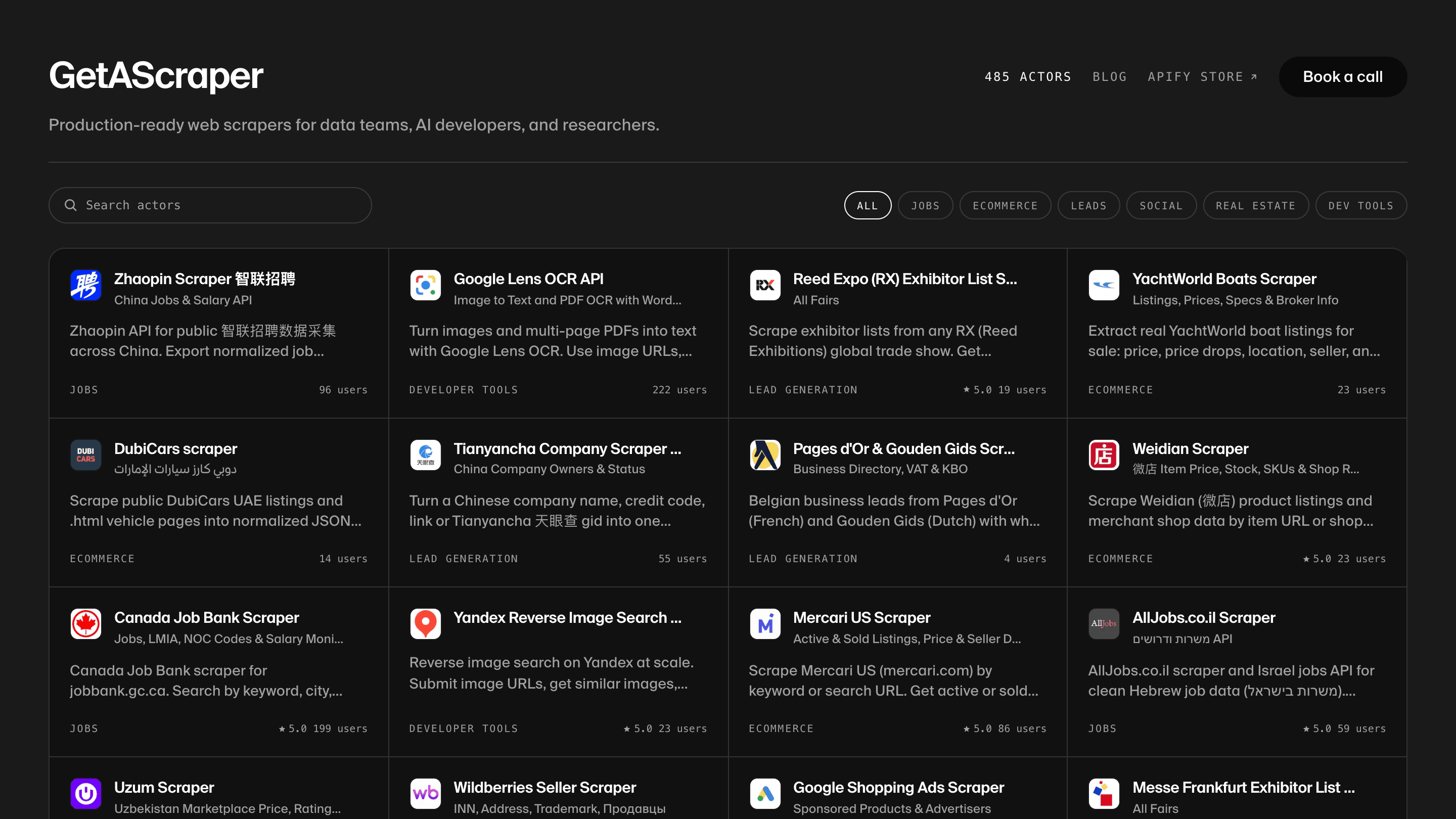
Shipped480+ production web scrapers on Apify that turn sites without APIs into clean, scheduled data feeds.
Founder, sole engineer · GetAScraper (own product) · 2026
- Public scrapers
- 480+
- Runs a month
- 60k+
- Run success
- 99%+
- Rating, 140+ reviews
- 4.8+
Problem
Teams need data from sites with no API, and one-off scripts break when the site changes.
What I built
Ready-made scrapers that share one schema, run on a schedule and return only what changed.
Result
Teams get a clean data feed without maintaining a scraper, and issues get answered in ~4h.
What it does
01
Monitor mode
Get only new or changed records on each run.
02
One schema per family
Same fields across sites, so data lands in one table.
03
Merged feeds
12 Indian or 9 Chinese job boards in a single run.
04
Data that AI can use
RAG-ready chunks, and callable by AI agents.
05
Delivery where teams work
Schedules, webhooks, Google Sheets and n8n.
06
Reliability tracking
Success rate and running cost tracked for every scraper.
How one person runs it
480+ scrapers are too many to check by hand, so the system checks itself and asks me only when a decision is needed. I can set up the same safety net on your project.
When a scraper breaks
Live- 1
A run fails
on 100+ busiest scrapers
- 2
Alert in minutes
likely cause attached
- 3
AI drafts a fix
tested on a copy
- 4
I approve
one tap, this change only
- 5
Fix ships
build checked
When I add a scraper
In use- 1
Demand check
is anyone looking for it?
- 2
Agents build and test
up to 5 at once
- 3
I review the code
every scraper
- 4
Goes live
pricing and store page
Guardrails
- 12 agent runs a day, max
- $2 a day test budget
- 1 fix per scraper at a time
- Approval expires in 48h
- Ignores instructions inside web pages
Tech Stack
All projects- TypeScript
- Node.js
- Apify SDK
- Crawlee
- Playwright
- Cheerio
- got-scraping
- n8n
- Next.js
 TypeScript
 Node.js
 Playwright
 Next.js
Read the full write-up3 min read
The problem
Teams building AI products, lead lists and market research keep needing data from websites that have no API. Their options are a one-off script that breaks the next time the site changes, or a data vendor with a sales call, an annual contract and weeks of setup. Either way the team ends up owning a pipeline they never wanted to maintain.
Highlights
- 480+ public scrapers on Apify, run 60k+ times a month with 99%+ of runs succeeding
- Rated 4.8+ across 140+ reviews, with issues answered in about 4 hours
- 150+ scrapers have a monitor mode: schedule them and get only new or changed records
- One feed merges 12 Indian job boards into a single schema; another searches 9 Chinese job boards in one run
- Covers the sources most teams give up on: Chinese job boards, Russian and Central Asian marketplaces, Middle East classifieds, Japanese and Indian job sites
What I built
- Monitor mode
- Scrapers remember what they returned last time and deliver only new or changed records. A team can schedule a feed hourly or daily without paying to re-download the same listings.
- One schema per family
- Job, marketplace, listing and company scrapers share field names, IDs and salary or price normalization, so data from different sites lands in one table without cleanup.
- Merged feeds
- Some feeds combine many sources in one run. India Jobs pulls 12 job boards into a single schema, and China Jobs searches 9 Chinese boards at once with salaries in one monthly format.
- Data that AI can use
- Extractors return token-counted chunks ready for RAG, and every scraper can be called by AI agents through Apify's MCP server and API.
- Delivery where teams work
- Runs on schedules and ships results to the Apify API, webhooks, Google Sheets and n8n. Four published n8n templates wire scrapers into ready-made workflows.
- Reliability tracking
- An internal dashboard tracks success rate, usage and running cost for every scraper, so breakage shows up as a number before it shows up as a support ticket.
How one person runs it
- Alerts on customer runsLive
- Apify only tells you when your own runs fail, so a customer's broken run used to go unseen. Now every run on 100+ of the busiest scrapers reports back when it ends. A failure reaches my phone within minutes with the likely cause, like running out of memory or timing out. Repeats of the same bug arrive as one message.
- An AI agent drafts the fixLive
- When a scraper fails Apify's daily check twice, an AI agent looks for the cause and writes a fix. It tests the fix on a separate copy while the live scraper keeps running. Then I get one message with the change and approve or reject it with a tap. The agent starts before Apify would mark the scraper as broken.
- Hard limits on the agentLive
- The agent runs at most 12 times a day and spends at most $2 a day on test runs. It works on one fix per scraper at a time. My approval covers only the exact change I reviewed and expires after 48 hours. It reads website text and user inputs as plain data and takes no instructions from them, so a web page can't talk it into anything.
- New scrapers wait for my reviewIn use
- Up to five builder agents work at once. Each one checks there is demand, builds the scraper and tests it, then stops until I read the code. Pricing and the store page go live only after that. 30+ scrapers have shipped this way, and 20+ ideas were dropped at the checks.
More numbers
230k+
Total runs
~4h
Issue response
- 4
n8n templates
Related Projects
Interested in working together?